
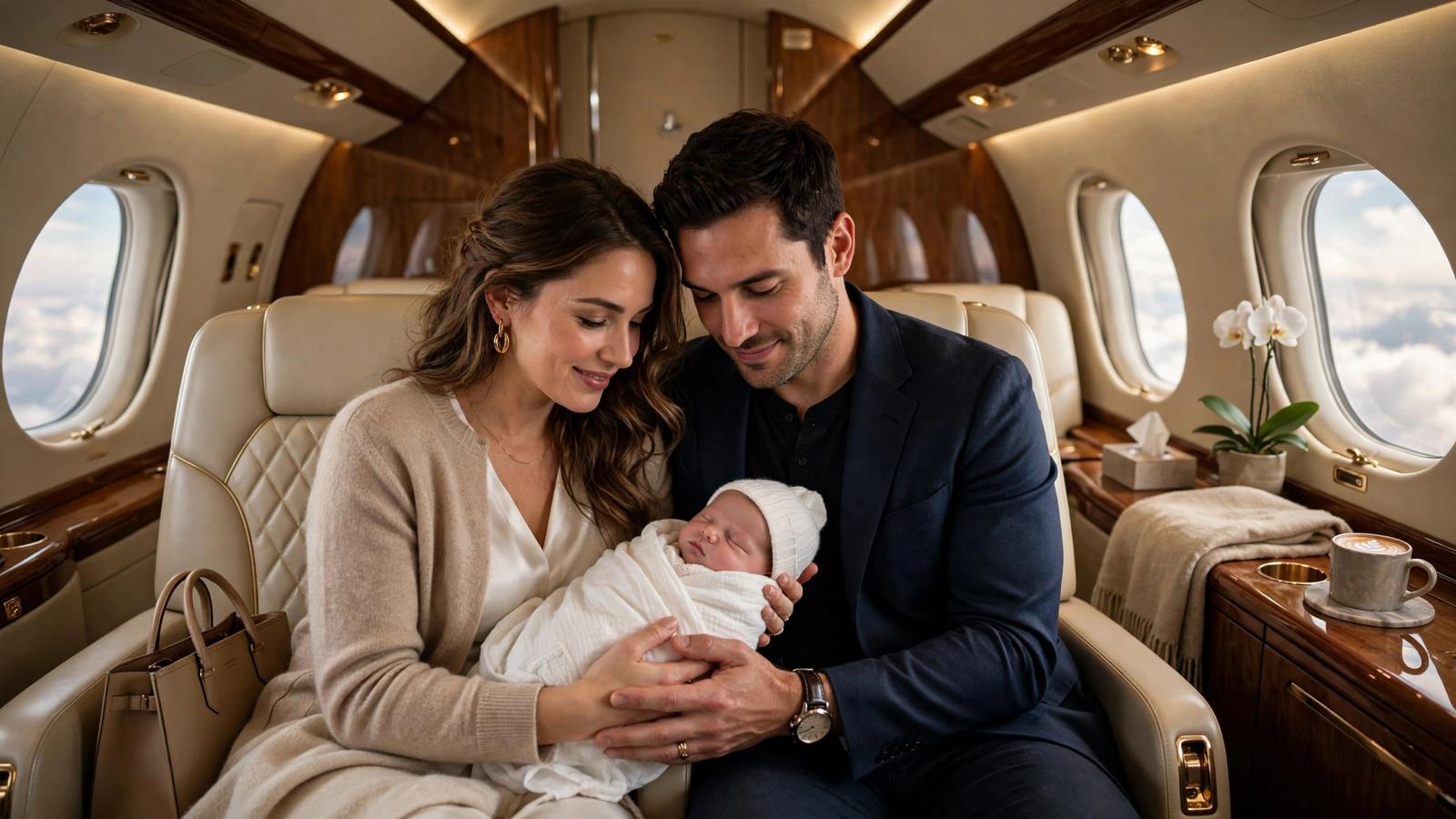
Flying with an infant on a private jet is possible, but traveling with a very young child involves some specific considerations that are helpful to know before departure.
These include, above all , changes in cabin pressure during the flight, cabin noise, and how the infant is positioned and secured during the various stages of the journey.
It’s not just a matter of organizing everything the baby needs. Even seemingly minor details, such as feeding times or the choice of a child restraint system, can become important during takeoff, descent, and landing.
In a nutshell: What to know before you go:
-
A healthy, full-term newborn can generally fly, but the decision should be made in consultation with the pediatrician, especially during the first week of life.
-
Ear discomfort occurs mainly during descent: sucking, a bottle, or a pacifier can help equalize the pressure.
-
Cabin noise depends on the specific aircraft and seat location, not simply on the fact that you’re flying on a private plane.
-
Holding a newborn in your arms does not count as a child restraint system: the approved child restraint system must be arranged with the airline staff before departure.
-
It’s best to indicate the presence of the infant when making your flight reservation, along with any car seat you plan to use.
Cabin Pressure and a Newborn’s Ears
One of the issues that most concerns parents is atmospheric pressure. The cabin of a private jet is pressurized. The problem for a newborn, therefore, is not simply the altitude reached by the aircraft, but above all the change in pressure during ascent and descent.
When the airplane changes altitude, the cabin pressure also changes. The middle ear must adapt to these changes through the Eustachian tube, the canal that allows pressure to be equalized on both sides of the eardrum.
In very young children, this mechanism may be less effective. For this reason, ear discomfort may occur mainly during descent, when the aircraft approaches the airport’s altitude. Swallowing helps equalize pressure. For an infant, therefore, breastfeeding, bottle-feeding, or using a pacifier can be helpful, especially during phases when the pressure changes.
The type of private jet also plays a role. The pressure felt in the cabin depends on the cabin altitude—that is, the equivalent altitude maintained by the pressurization system.
In principle, the lower the cabin altitude during cruise, the smaller the overall pressure change that needs to be compensated for as the aircraft descends toward the airport. This isn’t the only factor—the rate at which pressure changes also matters—but it’s an additional consideration when choosing a jet. We’ve explained how this varies from one model to another in our article on cabin pressure in private jets.
Why does a newborn cry during the descent of a private jet?
Crying during the descent doesn’t necessarily mean that the newborn is afraid of flying. One possible cause is ear discomfort caused by changes in pressure.
During descent, the pressure inside the cabin gradually increases, and the middle ear must adjust. In infants, this process can be more difficult and may cause a sensation of pressure or pain.
Swallowing helps equalize pressure. For this reason, during the descent, it may be helpful to breastfeed your baby or offer him or her a bottle or a pacifier, if he or she already uses one.
Nasal congestion can make it more difficult to equalize pressure. If your child has an ear infection, a bad cold, or other specific conditions, you should consult your pediatrician before departure.
Feeding helps the newborn feel less discomfort during the flight
During takeoff and especially during descent, as we’ve seen, changes in cabin pressure can cause discomfort in a newborn’s ears. Feeding can be helpful at these times, because sucking and swallowing help equalize pressure in the middle ear.
For this reason, if possible, it may be helpful to breastfeed the baby during the ascent and especially during the descent, when external pressure increases. A bottle or pacifier can also encourage swallowing and help reduce discomfort.
However, it is not necessary for the infant to eat at all costs: the goal is to encourage sucking and swallowing at times when the pressure changes. If the baby has a very stuffy nose, a severe cold, or an ear problem, it is advisable to consult the pediatrician before the flight.

-
Offer the breast, a bottle, or a pacifier when the pressure changes, paying particular attention to the descent phase;
-
ask the flight crew to let you know when the descent is about to begin, so you can time the feeding accordingly;
-
If the baby is sleeping, ask the pediatrician whether it’s best to gently wake the baby to offer a drink before the descent;
-
Keep more than one pacifier and a ready-to-use bottle within reach, so you don’t have to rummage through your luggage for them;
-
If the infant is secured in a child restraint system (CRS), remember that breastfeeding during takeoff and landing would require unbuckling the child: a bottle or pacifier is more practical (we discuss this in the section on restraint systems).
Private Jet Takeoff and Landing: The Phases Requiring the Most Attention
For a newborn, takeoff and landing are different from the normal cruise phase.
During takeoff, the cabin pressure gradually decreases as the aircraft climbs. During descent, the opposite occurs: the pressure increases as the jet loses altitude.
Ear discomfort is most likely to occur during the descent. For this reason, it may be helpful to plan your baby’s feedings with this phase of the flight in mind, so as to encourage sucking and swallowing precisely when they may be most helpful.
Of course, it’s impossible to predict how a baby will behave: some newborns don’t seem bothered at all, while others may start crying right as the plane begins its descent.
In practice, the ascent is usually the least problematic phase, because the air in the middle ear expands and tends to flow out more easily through the Eustachian tube. It is during the descent, when pressure increases, that the newborn needs help the most.
Noise in the car: Is it a nuisance for a newborn?
Another aspect that is often overlooked is the noise produced by the aircraft.
A private jet is not necessarily a quiet environment. The noise level varies depending on the aircraft model, the cabin configuration, and the passenger’s seat location. The moment when engine noise is typically most noticeable is during takeoff, when the engines are operating at high power.
For a family with a newborn, this is a factor to consider when choosing a private jet. The various categories of aircraft have different characteristics in terms of cabin size, soundproofing, and interior layout.
Noise is primarily a matter of comfort during the flight, but high noise levels are also a concern when it comes to protecting children’s hearing. For this reason, when planning your flight, it may be helpful to ask the airline for information about the planned aircraft and the cabin configuration.
However, it would not be accurate to say, in general, that a private jet is always quieter than a commercial airliner: noise levels depend primarily on the specific aircraft and the cabin environment.
Seat Belts and Restraint Systems: How Should a Newborn Travel?
A child’s safety during a flight isn’t limited to takeoff and landing. Turbulence can also occur during the flight and strike unexpectedly.
For this reason, it is important to distinguish between a child held in an adult’s arms and a child secured in a Child Restraint System (CRS)—that is, a child restraint system approved for use on board an aircraft.
Under EASA regulations, child restraint systems fall under the category of Child Restraint Devices (CRD). The rules stipulate that the device may be used when it is compatible with the aircraft seat and meets the requirements for use on board.
For a private jet trip, therefore, this matter should be confirmed with the operator before departure, informing them that an infant will be on board and, if applicable, specifying the restraint system you intend to use.
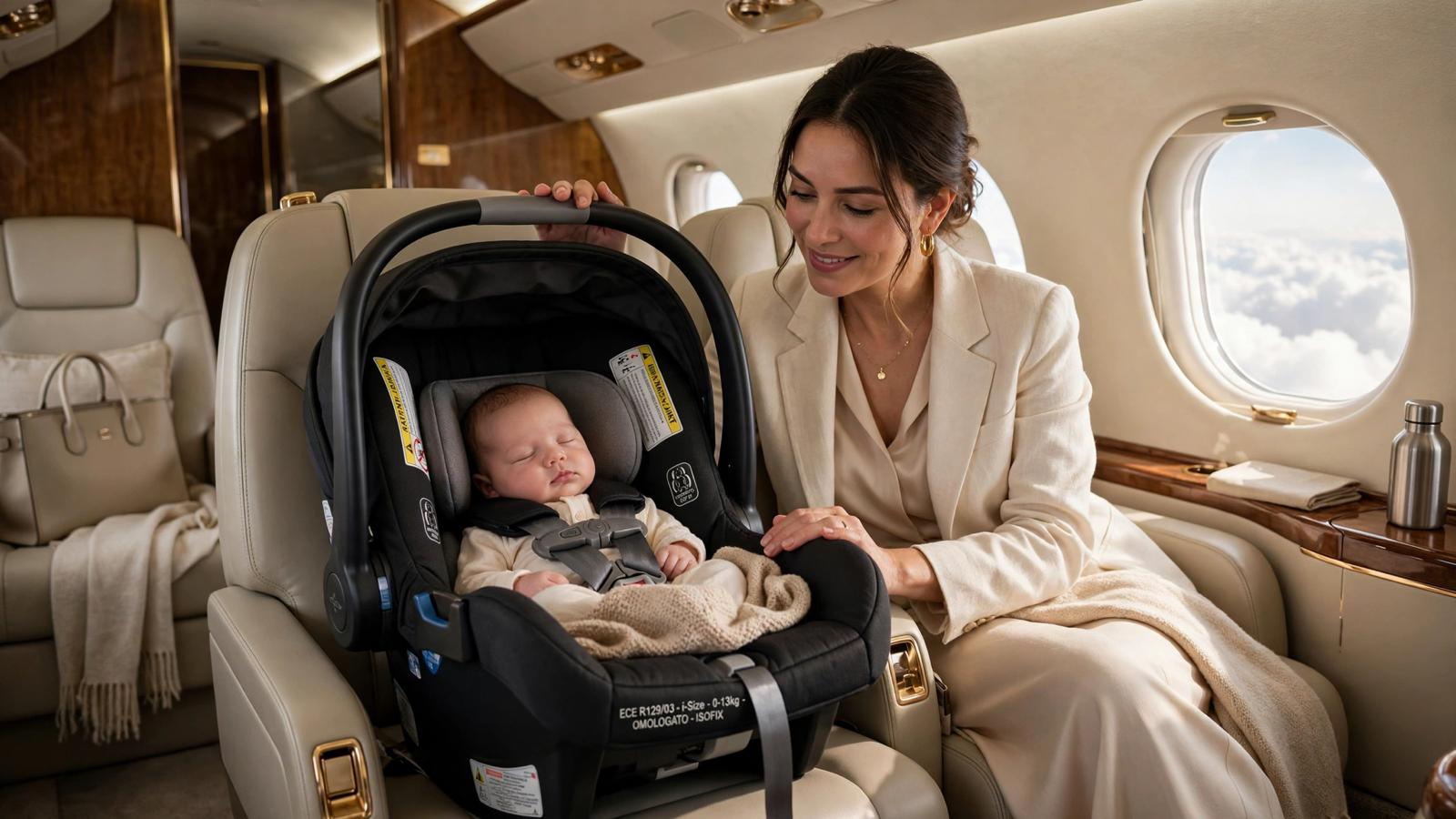
This allows you to check compatibility, installation procedures, and available space in the cab in advance.
Can an infant be held in your arms during a private jet flight?
Under certain conditions and in accordance with the rules applicable to the flight, an infant may be carried in an adult’s arms. However, this is not the same as a restraint system.
In fact, during sudden turbulence, an adult may not be able to hold onto a child, even if they are holding them tightly. The FAA, for example, designates an approved child restraint system (CRS) as the safest place for a child under two years of age and recommends using it during the flight.
When traveling by private jet, it is therefore important to verify before departure which systems are permitted on the aircraft being used and how they must be installed. The specific requirements may depend on the type of jet and the operator’s procedures.
Being allowed to hold a newborn in your arms and having the baby properly secured are two different matters.
What is a CRS, and which devices are approved?
CRS stands for Child Restraint System. Within the EASA context, the term CRD (Child Restraint Device) is also used.
However, it is not enough for a child safety seat to be certified for use in a car. To be used on board an aircraft, it must also have specific approval or certification for use in aircraft and be capable of being properly installed on the jet’s seat.
The devices that EASA considers acceptable include:
CRS approved for use in aircraft in accordance with the ETSO-C100c standard;
devices approved by EASA through a Type Certificate or Supplemental Type Certificate;
certain child seats approved for use in motor vehicles in accordance with ECE R44-03/R44-04 or ECE R129, provided they also have the required qualification for use in aircraft, for example, with the notation “For Use in Aircraft”;
Devices that comply with certain recognized standards in Canada, the United States, and Australia/New Zealand, provided they bear the relevant markings and approvals.
Breastfeeding and Car Seats: How to Balance Feeding Your Newborn and Safety Aboard a Private Jet
Breastfeeding can be very helpful in equalizing pressure, but it is not always compatible with the restraint system. If the infant is in the child restraint system (CRS), breastfeeding during takeoff and landing would require removing the infant from the seat, which is generally not permitted when the seat belt sign is on.
For this reason, it’s a good idea to plan your baby’s feedings before and after these phases and have a ready-to-feed bottle or a pacifier on hand for the descent. If you prefer to breastfeed, discuss this in advance with the flight attendant and your pediatrician to determine which option is feasible on the flight you’ve chosen.
What about during turbulence?
The fact that a private jet offers a more private cabin does not rule out the possibility of encountering turbulence.
Turbulence can occur even when the sky appears clear and can strike unexpectedly. An unsecured passenger may be thrown from or lifted out of their seat, which is why aviation authorities recommend keeping your seatbelt fastened when required and using appropriate restraint systems for children.
For a newborn, therefore, the restraint system should be considered essential—not just a matter related to takeoff and landing. Its purpose is to keep the baby properly secured even during phases of flight characterized by sudden movements.
When the seat belt sign is off, the flight crew will let you know if it is safe to unbuckle the infant, for example, to change or feed the baby. If turbulence is expected, it’s best to wait.
FAQ: Frequently Asked Questions About Flying on a Private Jet with an Infant
At what age can a newborn fly on a private jet?
According to the most widely accepted pediatric guidelines, a healthy, full-term newborn can fly as early as 48 hours after birth, but it is recommended to wait at least one week and to obtain the pediatrician’s approval. The airline’s restrictions should be verified at the time of booking.
If a newborn has a cold, can he or she fly on a private jet?
A mild cold doesn’t necessarily mean that a newborn can’t fly, but a stuffy nose can make it harder to equalize pressure changes during the flight and increase the risk of ear pain. If your child has a severe cold, a fever, ear pain, or an ear infection, it’s advisable to consult your pediatrician before departure.
During ascent and descent, sucking and swallowing can help equalize pressure: for a newborn , breastfeeding, a bottle, or a pacifier(if used regularly) can be helpful
Can a newborn baby be held in your arms during a private jet flight?
In some cases, the rules governing the flight permit this, but this does not constitute a restraint system. The safest solution is a child restraint system (CRS) approved for use on aircraft, which must be arranged with the operator prior to departure.
Can I use my own car seat?
Only if it is certified for use in aircraft and can be properly installed in the jet seat. Automotive certification alone is not sufficient, and the operator must confirm this in advance.
What should you do if your newborn cries during the descent?
Crying may be caused by ear discomfort due to changes in pressure. Offering a bottle or pacifier encourages swallowing and helps equalize the pressure. If your baby has an ear infection or a bad cold, consult your pediatrician before leaving.
Does having a newborn affect the rental cost?
As a general rule, the quote is based on the flight and the aircraft, not on the number of seats occupied: there is no ticket for an infant, as there is with scheduled airlines. Any additional services must be requested and confirmed in the quote.
Flying with an infant on a private jet: Preparation Makes All the Difference
Traveling with an infant on a private jet isn’t just a matter of bringing everything you need for the baby on board. Certain aspects of the flight, such as changes in pressure during descent, can directly affect the baby’s comfort, while the child restraint system is a key safety feature.
Preparing for the trip therefore also means familiarizing yourself with the aircraft, informing the airline staff that you are traveling with an infant, and checking in advance which child restraint systems are compatible.
For parents, understanding these aspects allows them to arrive at the airport with a better understanding of what might happen during the flight.
The information contained in this article is general in nature and is not a substitute for the advice of a pediatrician or the instructions of the flight crew.
Are you planning a charter trip with a newborn baby?
Contact PrivateJetFinder.com to request information about the flight that best suits your needs and to let them know in advance that there will be an infant on board.
In your request, please specify the infant’s age, the number of passengers, and the destination , and whether you plan to use a car seat: we can help you choose Planes and configuration that best suit your needs.
See also:
- Choosing Your Cabin Configuration: Pressurization, Relaxing Lighting, and Satellite Wi-Fi
- Say goodbye to travel fatigue: the best private jet cabin configurations for maximum comfort in flight