

Jeff Bezos and Elon Musk have chosen some of the most advanced business jets in the world. Jeff Bezos owns a Gulfstream G700, while Elon Musk’s fleet has just added a Gulfstream G800. These two aircraft are from the same family, sharing speed and technology, but with one key difference: the G700 prioritizes space and comfort, while the G800 focuses on maximum range. Furthermore, there is a particularly interesting detail about Musk’s G800: the presence of Starlink hardware.
Before comparing the two billionaires’ private jets, a clarification is in order: Jeff Bezos and Elon Musk have built technology and industrial empires that operate on a global scale, and for both of them, time spent traveling is a very valuable resource. But their planes reflect two slightly different interpretations of the same concept of private mobility.
In this article, we’ll try to compare the two aircraft, fully aware that both Jeff Bezos’s G700 and Elon Musk’s G800 are Gulfstream’s flagship models—business jets that excel in every respect.
Jeff Bezos’ Gulfstream G700
The G700 that Jeff Bezos flies in was designed by Gulfstream with a focus on cabin size and luxury.
It is 17.35 meters long, 2.49 meters wide, and 1.91 meters high, with an interior volume of 73.71 cubic meters. It can be configured with up to five living areas, accommodate up to 19 passengers, and provide sleeping accommodations for up to 13 people.
These figures explain why the G700 is considered, above all, an aircraft designed for comfort.
The Gulfstream G700’s cabin can, in fact, be divided into several distinct areas, with zones designated for work, dining, relaxation, and rest. Gulfstream also offers configurations that may include a large aft suite with a shower or a layout featuring an UltraGalley and a dedicated crew compartment.
Gulfstream G700: a range of over 14,000 kilometers
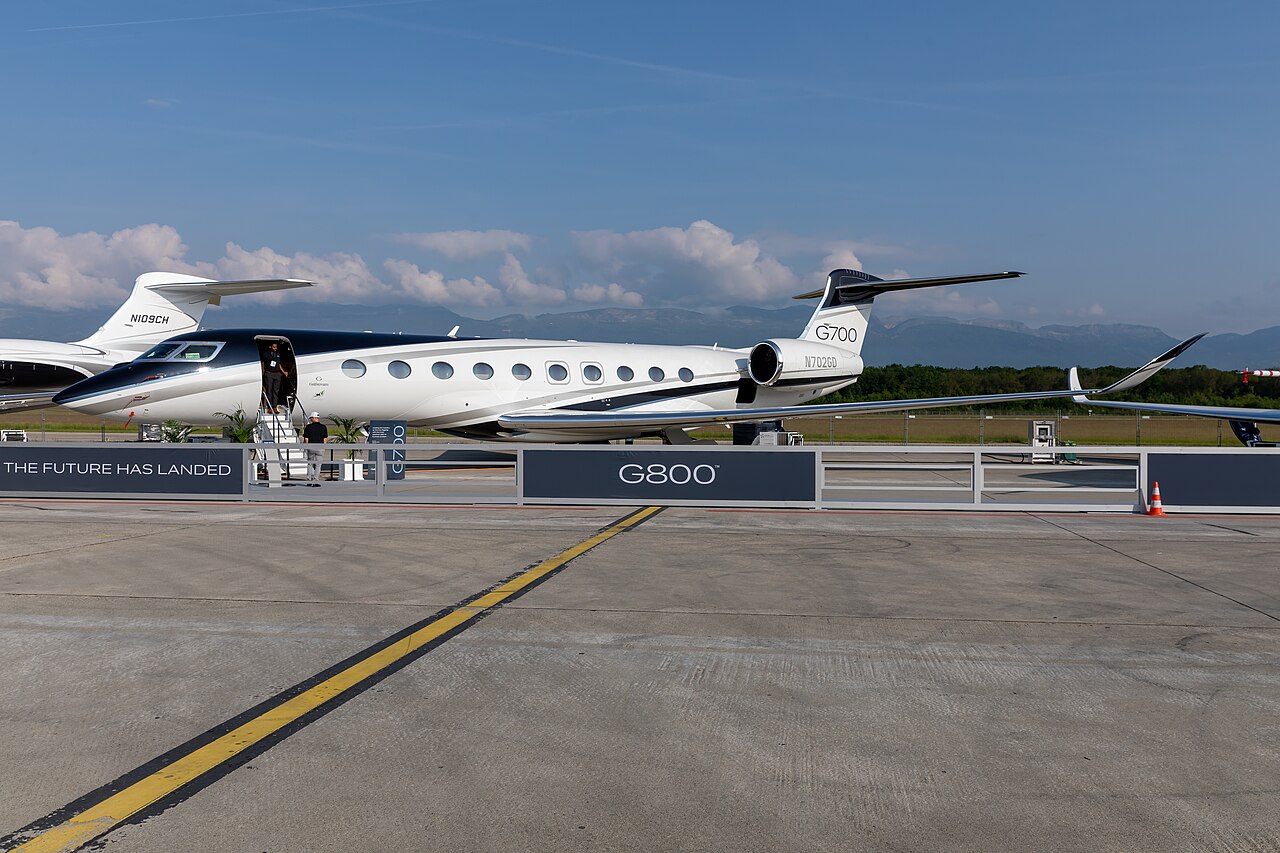
Although the most striking feature of this aircraft is the size of its cabin, that doesn’t mean the G700 has sacrificed range.
Gulfstream, in fact, states that the G700 modelhas a maximum theoretical range of 7,750 nautical miles—equivalent to approximately 14,353 kilometers—at a long-range cruise speed of Mach 0.85. This figure is calculated according to the NBAA IFR profile with eight passengers, four crew members, and the required fuel reserves.
At Mach 0.90—the so-called high-speed cruise—the stated range drops to 6,650 nautical miles, or about 12,316 kilometers. The maximum operational speed, on the other hand, reaches Mach 0.935.
Of course, these figures should not be interpreted as a guaranteed range on every route. Wind, weather conditions, aircraft weight, interior configuration, and routing dictated by air traffic control can significantly affect the actual range.
Elon Musk and the Gulfstream G800
On the other side of the comparison is the Gulfstream G800, the business jet that takes the concept of ultra-long-range flight to the next level.
The model associated with Elon Musk, a Gulfstream GVIII-G800 manufactured in 2026, represents the top of the Gulfstream lineup in terms of range.
In fact, the manufacturer specifies a maximum range of 8,200 nautical miles—equivalent to 15,186 kilometers—based on the theoretical NBAA IFR profile at Mach 0.85. That is approximately450 nautical miles—over 830 kilometers—more than the G700.
The difference may seem modest on paper, but it takes on significant importance when it comes to intercontinental flights: greater range can allow for the planning of routes that would require a stopover with another business jet.
Gulfstream G800: Less Space, but Greater Range
The comparison becomes even more interesting once you step inside the cabin.
Because the G800, despite having the longest range, isn’t any bigger than the G700. In fact, it’s actually a few meters shorter in length.
The cabin of the Gulfstream G800 measures 14.27 meters, compared to 17.35 meters for the G700. The interior volume is 60.54 cubic meters, compared to 73.71 cubic meters for the G700.
The living areas are also different:
- G700: up to 5 living areas.
- G800: up to 4 living areas.
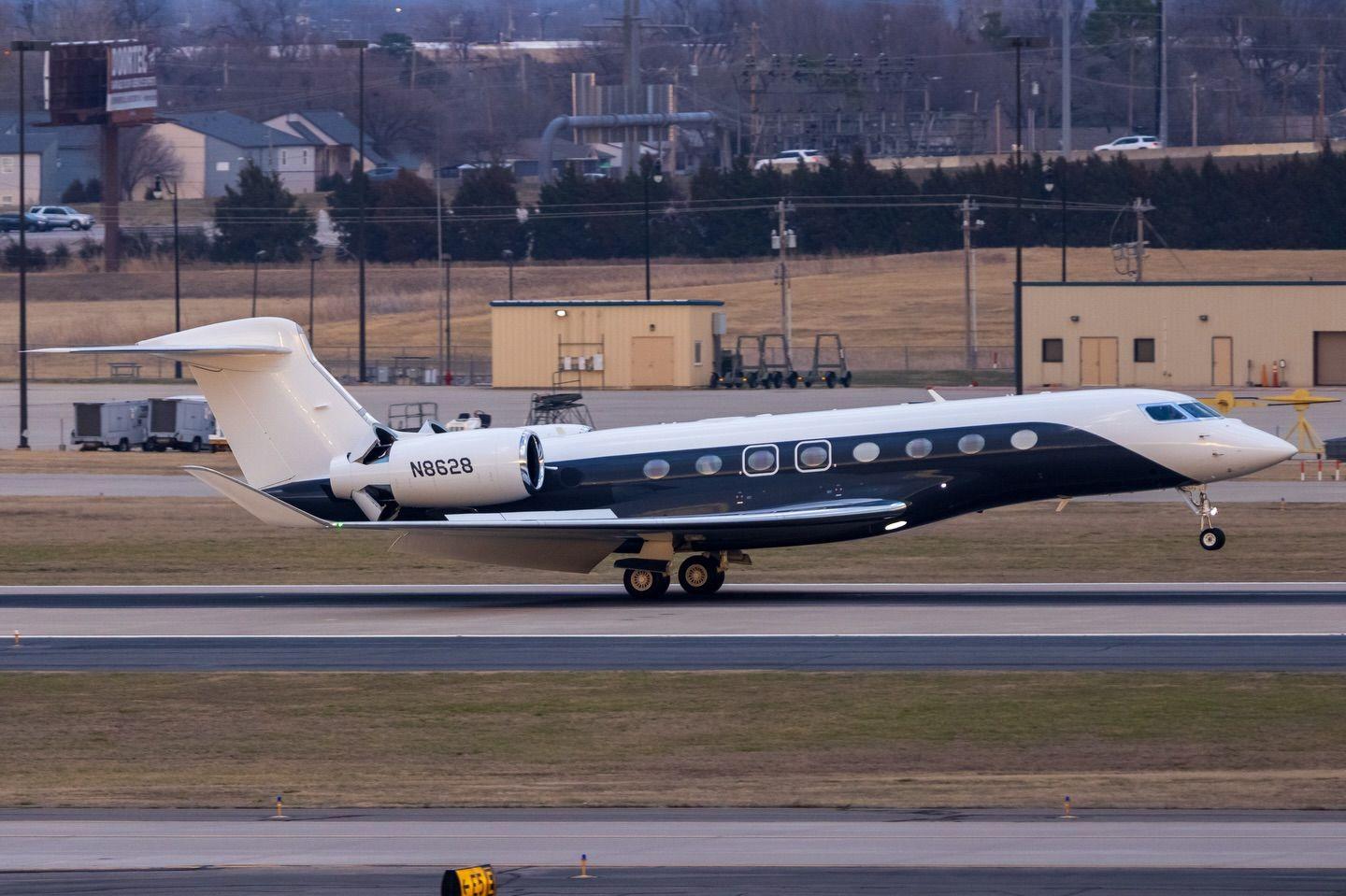
In any case, the Gulfstream G800 can still carry up to 19 passengers, but the maximum number of berths drops to 10, compared to 13 on the G700. The G800 also has 16 panoramic windows, compared to 20 on the G700.
The outcome of the comparison between these two private jet models is quite clear:
- The Gulfstream G700 makes better use of the aircraft’s size in terms of space and comfort.
- The G800 offers a more compact cabin to save space and prioritize flight range.
Gulfstream G700 vs. G800: A Technical Comparison
The main differences between these two “kings of the skies” from Gulfstream Airspaces can be summarized as follows.
Gulfstream G700
-
Range: 7,750 nm / 14,353 km
-
Long-range cruise: Mach 0.85
-
Range at Mach 0.90: 6,650 nm / 12,316 km
-
Maximum operational speed: Mach 0.935
-
Car: 17.35 m
-
Cabin volume: 73.71 m³
-
Living areas: up to 5
-
Passengers: up to 19
-
Sleeps: up to 13
-
Windows: 20
-
Engines: 2 Rolls-Royce Pearl 700
Gulfstream G800
-
Range: 8,200 nm / 15,186 km
-
Long-range cruise: Mach 0.85
-
Range at Mach 0.90: 7,000 nm / 12,964 km
-
Maximum operational speed: Mach 0.935
-
Cab: 14.27 m
-
Cabin volume: 60.54 m³
-
Living areas: up to 4
-
Passengers: up to 19
-
Sleeps: up to 10
-
Windows: 16
-
Engines: 2 Rolls-Royce Pearl 700
The figures are those reported by Gulfstream for standard configurations and the manufacturer’s theoretical conditions.
Starlink connection aboard Elon Musk’s G800
But the comparison between the two jets includes an element that goes beyond standard technical specifications.
The G800 used by Elon Musk is equipped with the Starlink Aviation system.
The presence of the hardware is evident from the aircraft’s documentation: for N8628, Supplemental Type Certificate ST04570AT is listed, pertaining to the installation of the SpaceX Starlink Aviation system. A public FAA STC database also identifies ST04570AT as the installation of the Starlink Aviation system on the G800.
This detail is particularly interesting because, as everyone knows, Starlink is a technology from Musk’s business empire.
It is, in fact, the satellite connectivity system developed by SpaceX.
Of course, Starlink Aviation isn’t a technology exclusive to Musk’s aircraft: the system can be installed on other business jets as well , and Gulfstream offers the option to equip its aircraft with satellite connectivity.
Musk flies aboard a Gulfstream capable of traveling more than 15,000 kilometers nonstop, while also having access to satellite technology developed by his own space company. His G800 thus becomes more than just a means of transportation.
A mobile office that’s always connected
Connectivity takes on special significance on an aircraft like the Gulfstream G800.
The business jet is designed for extremely long flights and can spend many hours away from land. The ability to maintain a high-speed connection during the flight allows passengers to continue working, communicating, attending meetings, and accessing online services even while the aircraft is crossing oceans.
Air travel eliminates physical distance; satellite connectivity reduces digital distance.
For an entrepreneur like Elon Musk, whose business interests span from automotive technology to the space industry, from artificial intelligence to telecommunications, this combination takes on special significance.

This plane isn’t just meant to take Musk from one city to another; it’s also meant to allow him to continue working while flying from one part of the world to another.
Gulfstream G700 or G800: Which private jet offers more comfort?
If space is the deciding factor, the Gulfstream G700 clearly has the advantage. The difference of more than three meters in cabin length and more than 13 cubic meters in interior volume is not insignificant.
The G700 also offers up to five living areas and sleeps up to 13 people. Gulfstream explicitly markets it as its business jet with the most spacious and flexible cabin.
The G800 sacrifices some of this space in favor of range, although that doesn’t mean it’s any less luxurious. The difference, therefore, isn’t between a luxurious jet and a less luxurious one.
It lies between two different project priorities.
Which of the two planes is faster?
In this regard, Bezos’s Gulfstream (G700) and Musk’s Gulfstream (G800) are essentially on par.
The G700 and G800 both reach a maximum operating speed of Mach 0.935.
Both also use two Rolls-Royce Pearl 700 engines, with a stated takeoff thrust of 81.20 kN per engine.
The G800’s advantage, therefore, is not its speed, but its ability to maintain a long range even at high cruising speeds. At Mach 0.90, for example, the G800 has a theoretical range of 7,000 nautical miles, compared to the G700’s 6,650.

How much do the Gulfstream G700 and G800 cost?
The price of these aircraft is only part of the story.
The final cost of a business jet in this category depends on the configuration, avionics, cabin customization, and the numerous available options.
For this reason, it is more accurate to speak of a reference price rather than a definitive cost that is the same for all aircraft.
And in the case of Jeff Bezos’s and Elon Musk’s private jets, we must be even more cautious: we do not have a verified public price for the specific configuration of their individual aircraft, but we can certainly assume that it exceeds $80–90 million.
Is Gulfstream the king of luxury private jets?
A comparison between Jeff Bezos’s Gulfstream G700 and Elon Musk’s G800 shows just how high the bar has been set in the ultra-long-range business jet segment today.
Gulfstream Aerospace is one of the world’s leading names in this category, alongside Bombardier and Dassault Aviation, which also offer aircraft designed to provide high levels of range, comfort, technology, and customization.
It is therefore important to clarify one aspect of the comparison between Gulfstream’s two flagship models: both are ultra-long-range jets, designed to offer high levels of comfort and intercontinental performance, but they differ in certain respects.
As we have seen, the Gulfstream G700 features a particularly spacious cabin, with an interior volume of 73.71 m³, up to five living areas, and great flexibility in the layout of the spaces. The G800 maintains the same level of comfort and technology but uses a more compact cabin to achieve an even greater range: 8,200 nautical miles compared to the G700’s 7,750.
In both cases, these are private jets that are fully capable of handling intercontinental flights without compromising on high-end interiors. The G700 offers more space, while the G800 offers even greater range without sacrificing comfort.
A comparison with competitors also confirms that there is no single criterion for determining which is the best business jet. The Bombardier Global 8000 competes in the same segment by combining range, speed, and comfort, while the Dassault Falcon 10X focuses specifically on cabin size and flexibility, with an interior volume of 78.7 m³.
When evaluating top-of-the-line private jets, the choice therefore depends on personal needs and preferences. Range, performance, comfort, cabin space, technology, and the ability to customize the interior may carry different weight depending on the type of trip.
If you’re considering a private flight, you can check the aircraft available for charter on PrivateJetFinder and see which models are available for your route.