

In-flight connectivity has become one of the most talked-about topicsin private aviation, and Starlink has quickly established itself as the industry standard. But what does it really mean to have Starlink on a private jet, how is it installed, and—especially after the recent price increases—how much does it cost to keep it active? Let’s take a closer look.
What Is Starlink Aviation?
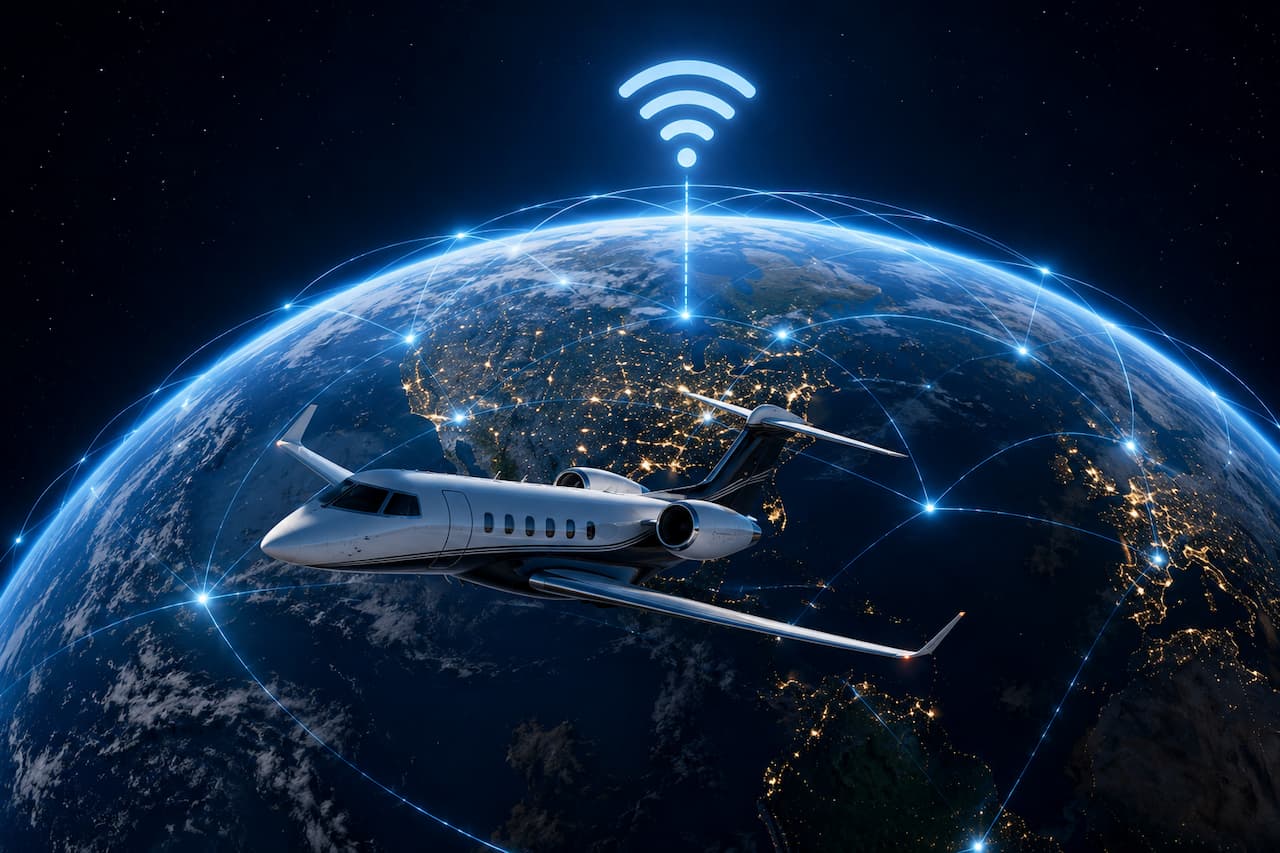
Starlink Aviation is the division of SpaceX’s satellite service designed specifically for commercial and private aviation. It is based on the same constellation of low-Earth orbit satellites that made Starlink famous to the general public, but with hardware and pricing plans tailored to the needs of aircraft in flight: global coverage, high speeds, and much lower latency than the traditional satellite solutions previously used in the industry.
For frequent private jet travelers, this translates to a connectivity experience comparable to that of an office on the ground: uninterrupted video calls, streaming, sending large files, and continuous access to corporate email—even on the longest transoceanic flights.
As we previously mentioned in our in-depth article on internet and Wi-Fi on private jets, until recently, in-flight connectivity relied primarily on air-to-ground networks or geostationary satellites (Ka-band, Ku-band, L-band), with long-standing providers such as Gogo, Viasat, Inmarsat, and Honeywell. Starlink represents a technological leap forward compared to these solutions, thanks to its constellation of low-Earth orbit satellites: higher speeds, much lower latency, and more uniform coverage, even over ocean routes.

How Does the Starlink Connection Work on Private Jets?
Installing Starlink on a private jet is not a simple plug-and-play device, but a system consisting of several components:
-
a satellite antenna (known as an “air terminal”), mounted externally on the fuselage or tail of the aircraft, designed to operate reliably even while in flight and at high altitudes;
-
a modem and a Wi-Fi router installed in the cabin, which distribute the signal to passengers and crew;
-
integration with the aircraft’s electrical system and existing wiring.
One of the most technically challenging aspects is managing the seamless handoff between moving satellites: the system must ensure that the connection is never interrupted, a fundamental requirement for sensitive applications such as voice calls or cockpit data links.
Furthermore, each installation requires a specific regulatory certification for the aircraft model in question—the so-called Supplemental Type Certificate (STC), issued by agencies such as the FAA in the United States and EASA in Europe—as well as dedicated technical inspections and flight tests.
In-Flight Performance: How Fast Is the Starlink Connection?
Performance varies depending on the plan and the antenna installed, but in general, Starlink Aviation offers speeds significantly higher than any previous satellite solution in the business aviation sector. Depending on the configuration, speeds range from 220 Mbps up to 1 Gbps with the “performance” class aviation antenna, with very low latency. In practice, streaming, video conferencing, and large file transfers become manageable even at an altitude of 12,000 meters.
Costs: The Price Hike That Has Sparked Debate in the Private Aviation Sector (as of August 7, 2026)
Here’s the most up-to-date information, and it’s useful to know this before deciding whether to use the Starlink connection on your own aircraft or charter flight. Starting August 7, 2026, new prices will take effect, replacing the previous plans, and the increase is not insignificant:
-
The Aviation Global Unlimited plan—which offers worldwide coverage wherever the service is available and speeds of up to 1 Gbps—is now priced at $20,000 per month, effectively double the previous price;
-
The Aviation Regional Unlimited plan—with speeds of up to 500 Mbps, coverage limited to specific continents, and up to 12 nautical miles from the coast—is increasing by 25%, reaching $12,500 per month. It should be noted, however, that this regional plan still leaves some dead zones along routes that cross areas such as the Gulf of Mexico.
The news has sparked mixed reactions. Some have invested significant sums in the installation—one owner of a Bombardier Global 6000, among the first to adopt Starlink Aviation in 2024, spent over $300,000 on hardware and installation—and now faces a monthly cost that has doubled.
Starlink Aviation 2026: What’s Changing for Private Jet Charterers
For those considering chartering a private jet, the availability of a Starlink connection on board is rapidly shifting from a “luxury perk” to an expected feature, especially for business clients accustomed to staying connected at all times. At the same time, rising operating costs are a factor to keep in mind.
It’s also worth finding out about the difference between global and regional plans based on the routes you typically fly: those who fly mainly on intercontinental routes will need global coverage, while those who fly between destinations in Europe (London, Paris, Madrid, Milan) could assess whether the regional plan—though more cost-effective—truly covers all relevant routes, including the most critical coastal areas.

Fly with the connection (and jet) that’s best for you
In-flight connectivity is now an integral part of the private flight experience, but choosing the aircraft, operator, or charter package that best suits your needs remains a decision that requires careful consideration of many technical and financial details—not just Wi-Fi . If you’re evaluating your options for your next private flight, please contact us.
The Staff Privatejetfinder.com will be able to provide you with all the information and up-to-date pricing for the new Starlink Aviation connection rates so you can stay connected throughout your luxury flight.